
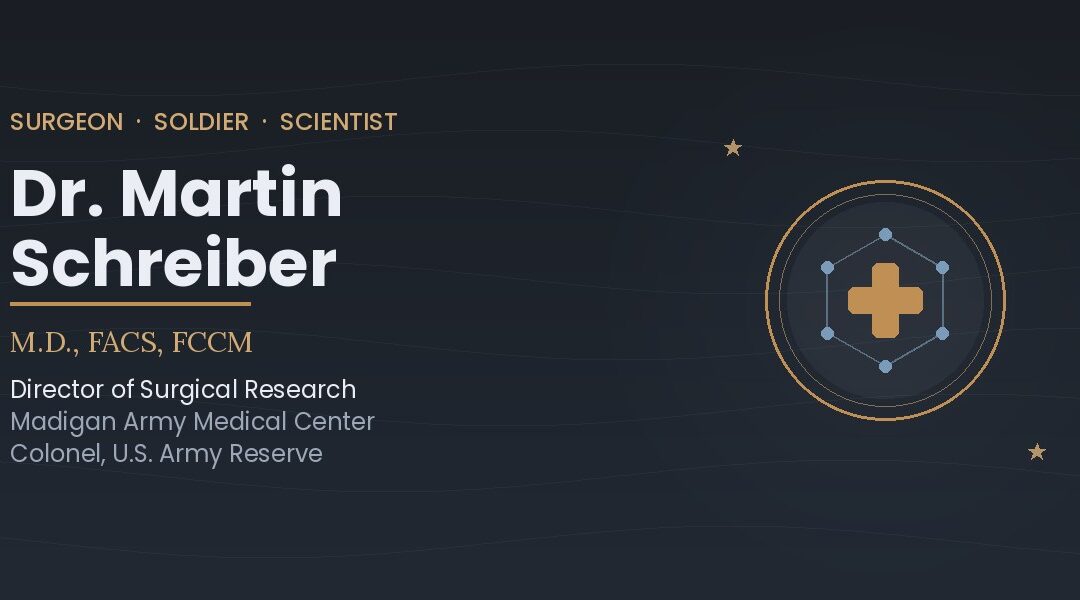
Some careers follow a straight line. Dr. Martin Schreiber’s career follows two lines that keep crossing. He has been a surgeon and a soldier since 1984, and those two identities have shaped almost everything he has done since. He operates on badly injured patients, he studies why some of them do not survive, and he has carried that work from university trauma centers to combat hospitals overseas and back again.
In 2026, he brought those threads together in a single role. He returned full time to the institution where he first trained and now serves as Director of Surgical Research at Madigan Army Medical Center on Joint Base Lewis-McChord in Washington State. This article looks at the career behind that role and the research mission that drives it.
Two Careers, One Purpose
Dr. Schreiber holds the rank of Colonel in the Medical Corps of the U.S. Army Reserve. He has worn that uniform for decades, and he has also built a long academic career in civilian medicine, including many years leading trauma care and research at Oregon Health and Science University.
He did not keep those worlds separate. He volunteered for active duty when the country went to war, and he deployed three times, once to Iraq in 2005 and twice to Afghanistan, in 2010 and 2014. During those tours he took on demanding roles, including chief of surgery at the military hospital in Tikrit and director of the joint theater trauma system in Bagram. That experience gave him a direct view of what trauma care needs to solve, and it still shapes the questions he chooses to study.
Research Aimed at the Deadliest Problems
Dr. Schreiber has authored more than 350 peer-reviewed publications, along with book chapters and other scholarly work. His research is supported by the Department of Defense, the National Institutes of Health, and industry partners, and it stays focused on two of the biggest causes of preventable death and disability in injured patients.
The first is traumatic brain injury. The second is hemorrhagic shock, the life-threatening loss of blood that follows serious injury. His work looks closely at the earliest window of care, including the prehospital and far-forward setting, where medics and forward surgical teams often decide the outcome before a patient ever reaches a hospital. His studies over the years have influenced how teams approach resuscitation, blood products, and prehospital treatment.
Why the First Minutes Matter
Much of his focus lands on that interval between injury and definitive care. In brain injury, the secondary damage that happens during transport can be as dangerous as the original wound. In severe bleeding, the choices a team makes in the first minutes often decide whether a patient survives. Dr. Schreiber’s research asks a practical question. What can teams do in that window, with the tools and supplies they actually have, to give more patients a chance?
A Bridge Between Military and Civilian Medicine
One theme runs through all of it. Lessons learned in combat can improve care at home, and advances made in civilian labs can reach the battlefield. Dr. Schreiber has spent his career moving knowledge in both directions, and he has argued that the strongest military surgical research is built around the real physiological and logistical challenges of the field, not simply conducted by people in uniform.
His current appointments reflect that view. Alongside his role at Madigan, he serves as an Adjunct Professor of Surgery at the Uniformed Services University, which keeps his clinical and research work connected to the wider community of military medicine and its training programs.
Building the Next Generation
Dr. Schreiber has also spent years teaching residents, fellows, and younger surgeons, and he treats that work as central rather than secondary. He has described a simple chain of logic. The clinical work informs the research, the research informs the teaching, and the teaching develops the surgeon-scientists who will carry the work forward. For him, training the next generation is part of making sure the progress outlasts any single career.
Frequently Asked Questions
Who is Dr. Martin Schreiber?
Dr. Martin Schreiber is a trauma and critical care surgeon, a Colonel in the U.S. Army Reserve, and Director of Surgical Research at Madigan Army Medical Center. He is known for research on traumatic brain injury and hemorrhagic shock and for connecting military and civilian trauma care.
What does Dr. Schreiber research?
His research centers on traumatic brain injury and hemorrhagic shock, with a strong focus on the early and prehospital window of care. His work, funded by the Department of Defense, the NIH, and industry partners, has influenced resuscitation strategies, blood product development, and prehospital treatment.
Has Dr. Schreiber served in the military?
Yes. He has been a Colonel in the U.S. Army Reserve Medical Corps and has served since 1984. He deployed three times, to Iraq in 2005 and to Afghanistan in 2010 and 2014, including roles as chief of surgery in Tikrit and director of the joint theater trauma system in Bagram.
Where does Dr. Schreiber work now?
He serves as Director of Surgical Research at Madigan Army Medical Center on Joint Base Lewis-McChord in Washington State, and he remains an Adjunct Professor of Surgery at the Uniformed Services University.