
Freeze-dried plasma moved from a long-running research and military access story to a new U.S. regulatory phase in 2026. On July 29, the U.S. Food and Drug Administration licensed EZPLAZ, the first freeze-dried plasma product approved in the United States. The decision changes product availability. It does not, by itself, settle every clinical question about which trauma patients benefit, in which settings, or compared with which alternative.
Reading note
This article separates three questions that are often blended together: Can a dried plasma product preserve useful biological function? Can it be stored and delivered more easily? Does its use improve patient outcomes in a defined clinical setting? Evidence for one question does not automatically answer the others.
What changed in 2026
The FDA licensed EZPLAZ Freeze Dried Plasma for adults who require plasma when other plasma products are unavailable. The approved uses include selected bleeding or preoperative patients who need replacement of multiple coagulation factors, patients undergoing massive transfusion with clinically significant coagulation deficiencies, and certain patients taking warfarin.
According to the FDA’s product information, EZPLAZ is made from a single unit of fresh frozen plasma. It is supplied as group AB or low-titer anti-B group A plasma. Stability data support storage at 2–25°C (36–77°F) for up to 12 months. The product is reconstituted before transfusion and may be given intravenously or intraosseously.
Regulatory fact
First U.S. license
FDA licensed EZPLAZ on July 29, 2026, for specified adult uses when other plasma is unavailable.
Product fact
Single-donor plasma
The licensed product is lyophilized from one unit of fresh frozen plasma and reconstituted before use.
Required follow-up
Postmarket study
FDA required a phase 4 safety study with thrombotic and thromboembolic events as the primary endpoint.
That final point matters. Approval means the agency concluded that the submitted evidence supported the licensed indication and manufacturing standards. It does not mean the evidence base is complete. The FDA’s Summary Basis for Regulatory Action specifically records a required postmarketing safety study.
What freeze-drying changes—and what it does not
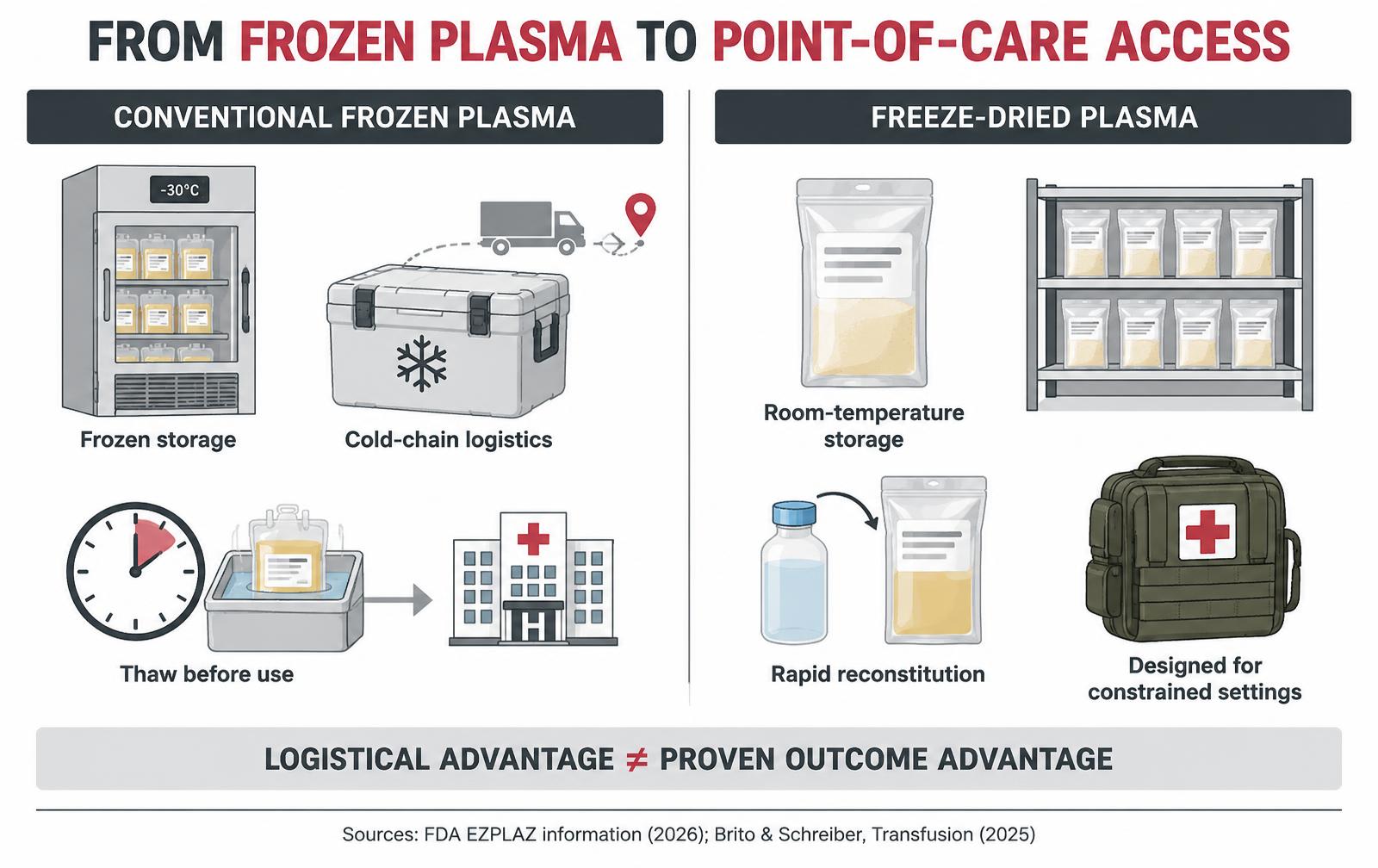
Plasma contains coagulation proteins and other biologically active components. Conventional fresh frozen plasma preserves these components through freezing, but that creates a cold-chain requirement and a thawing step. Lyophilization removes water from frozen plasma under controlled conditions. The resulting dry product can be stored at room temperature and later reconstituted with sterile liquid.
A 2024 review in Life described the practical case for dried plasma: stockpiling, transport, and reconstitution may be easier where freezers, thawing equipment, reliable power, or rapid resupply are unavailable. Those constraints can occur in military operations, rural transport, disaster response, and other remote environments.
| Question | What can answer it? | What it cannot establish alone |
|---|---|---|
| Are key factors retained? | Biochemical and functional assays | Patient benefit |
| Does field storage preserve quality? | Stability and transport studies | Comparative effectiveness |
| Can clinicians deliver it reliably? | Usability and implementation studies | Mortality effect |
| Does it improve outcomes? | Well-designed comparative clinical studies | Benefit outside the tested population |
Drying is not a single uniform process. Freeze-dried and spray-dried products can differ by donor strategy, pathogen-reduction method, packaging, storage conditions, reconstitution procedure, and final composition. Researchers therefore need product-specific evidence rather than conclusions based only on the category name “dried plasma.”
What the clinical evidence shows so far
Evidence about prehospital plasma is broader than evidence about one freeze-dried product. This distinction is essential. Some trials used thawed or liquid plasma; others evaluated lyophilized plasma. Transport time, injury pattern, treatment protocol, and control care also differed.
A 2024 systematic review and meta-analysis combined three randomized trials with 760 participants at risk for hemorrhagic shock. It reported no statistically significant difference between prehospital plasma and standard care for 24-hour mortality, 30-day mortality, or multiple-organ failure. The plasma groups used fewer packed red-cell units over 24 hours and had a different INR on hospital arrival. The authors could not perform a useful subgroup analysis by fresh frozen versus lyophilized plasma because too few studies were available.
Why pooled results need context
The included trials did not produce identical results. The PAMPer trial reported a 30-day survival advantage during air-medical transport, while the COMBAT trial in a rapid urban transport system did not. PREHO-PLYO, which studied lyophilized plasma, also did not show a survival advantage. These differences support research into treatment context rather than a single universal conclusion.
More recent observational work also keeps the urgency visible. A 2025 multicenter analysis co-authored by Dr. Schreiber studied 1,051 patients at high risk for life-threatening hemorrhage. Of the 176 patients who died, 74% died within 24 hours, 56% within six hours, and 35% within three hours. Bleeding was the leading cause of death and occurred mainly in the first three hours. The study describes timing and cause; it does not test freeze-dried plasma.
Where Dr. Martin Schreiber’s work fits
Dr. Martin A. Schreiber is a trauma surgeon and researcher whose indexed publications span hemorrhagic shock, trauma resuscitation, blood products, coagulation, and traumatic brain injury. His current personal biography lists him as Director of Surgical Research in the Department of Surgery at Madigan Army Medical Center and Adjunct Professor of Surgery at the Uniformed Services University. This article uses that personal page only for the current-title statement; the scientific discussion rests on journal and government records.
In 2025, Alexandra M. P. Brito and Dr. Schreiber published Dried blood products: Current and potential uses in trauma in Transfusion. The review examines dried plasma, platelets, and red-cell products, including their history, logistical rationale, current development, and potential role when conventional blood products are difficult to supply. It provides an anchor for this topic, but it is a narrative review—not a randomized comparison and not evidence that every dried product has the same performance.
His broader publication record helps frame the translational problem. A 2024 mathematical-modeling study co-authored by Dr. Schreiber linked preclinical and PROMMTT patient data to simulate hemorrhagic shock resuscitation strategies. A 2024 Transfusion commentary addressed making blood immediately available in emergencies. A 2025 observational analysis found that patients receiving early whole blood were more likely to achieve a defined hemostasis endpoint than patients receiving component therapy. Each study asks a different question; none should be treated as a direct trial of the newly licensed freeze-dried product.
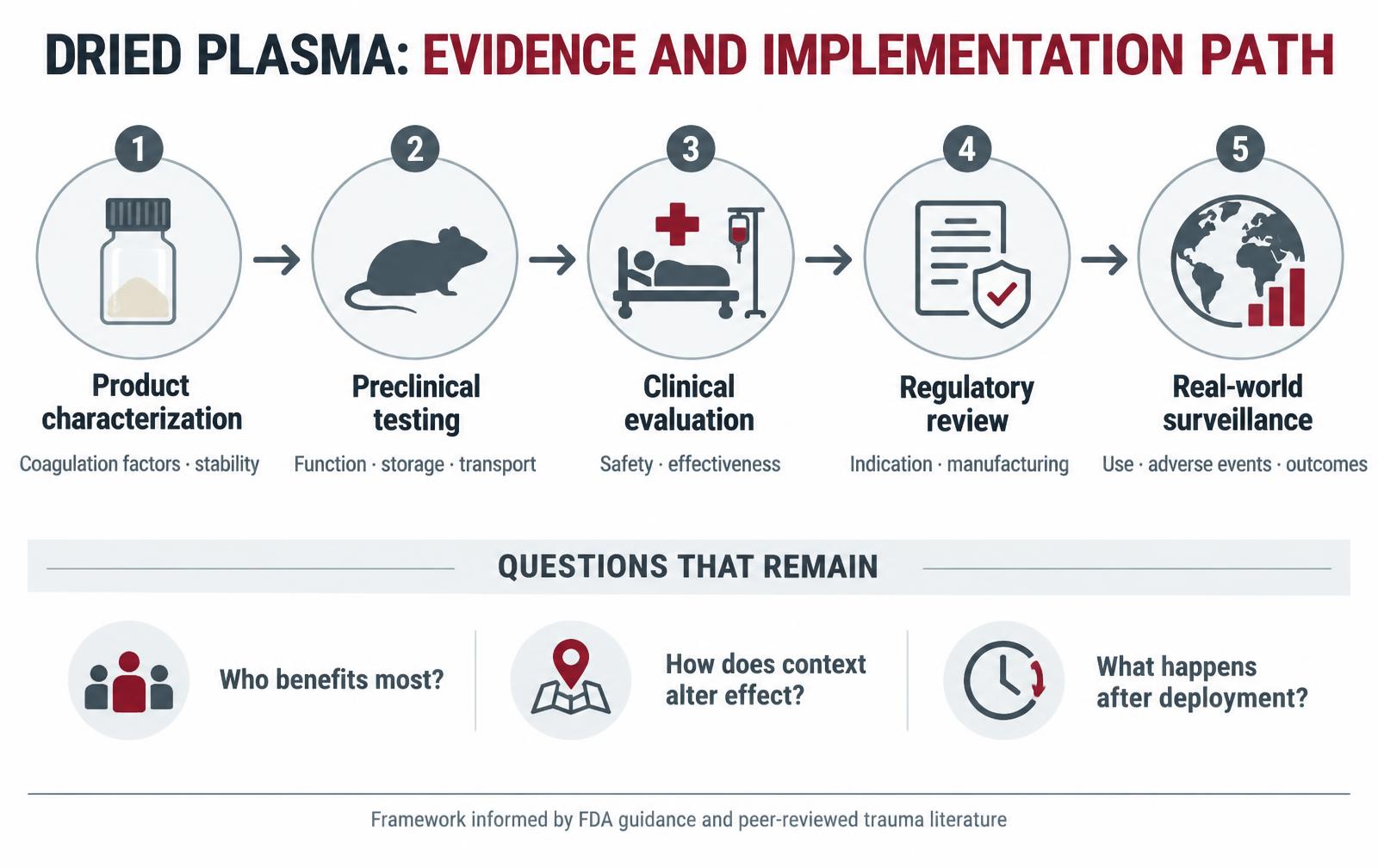
Six research questions that remain
-
01
Which patients are most likely to benefit?
Future studies need prespecified groups based on physiology, bleeding risk, transport time, injury pattern, and availability of other blood products. A benefit in prolonged transport may not appear in a short urban interval.
-
02
What is the right comparator?
Standard care can mean crystalloid, fresh frozen plasma, liquid plasma, whole blood, or component therapy. Comparative claims are only meaningful when the alternative is explicit.
-
03
How should time be measured?
Time from injury, dispatch, eligibility, product access, reconstitution, and transfusion answer different operational questions. Reporting only hospital arrival can hide the interval the product is designed to change.
-
04
Does preserved laboratory function translate to outcomes?
Factor activity, clot strength, and INR are valuable measures, but researchers should connect them to patient-centered outcomes and transfusion exposure.
-
05
What does real-world safety look like?
The FDA-required postmarketing study makes thrombotic and thromboembolic events a central surveillance question. Transfusion reactions, implementation errors, wastage, and product integrity also warrant tracking.
-
06
How transferable are results across settings?
Combat, air medical, rural ground transport, wilderness response, and disaster systems have different teams, timelines, storage conditions, and evacuation paths. External validity should be tested, not assumed.
The 2026 milestone changes the implementation question.
U.S. researchers can now study an FDA-licensed freeze-dried plasma product under its approved conditions of use. The next task is to measure where easier access changes care, where it does not, and what tradeoffs appear after wider deployment.
Sources and methodology
- U.S. FDA. First U.S. freeze-dried plasma license, July 29, 2026.
- U.S. FDA. EZPLAZ Summary Basis for Regulatory Action, June 29, 2026.
- U.S. FDA. EZPLAZ Circular of Information.
- Brito AMP, Schreiber MA. Dried blood products: Current and potential uses in trauma. Transfusion. 2025;65(5):1053–1066. doi:10.1111/trf.18220.
- Peng HT, et al. Dried Plasma for Major Trauma: Past, Present, and Future. Life. 2024;14(5):619.
- Abuelazm M, et al. The efficacy and safety of pre-hospital plasma in patients at risk for hemorrhagic shock. Eur J Trauma Emerg Surg. 2024;50:1075–1086.
- Bernhardt IM, et al. Timing of trauma deaths due to uncontrolled bleeding have not changed in three decades. Am J Surg. 2025. doi:10.1016/j.amjsurg.2025.116510.
- Cannon JW, et al. Digital twin mathematical models suggest individualized hemorrhagic shock resuscitation strategies. Commun Med. 2024;4:105.
- Holcomb JB, et al. Making blood immediately available in emergencies. Transfusion. 2024;64(S3):S42–S50.
- Chipman AM, et al. Early achievement of hemostasis defined by transfusion velocity. J Trauma Acute Care Surg. 2025;98(3):430–438.
- Defense Health Agency. FDA approval and military implementation context, September 2026.
- MartinSchreiber.co. Biography and current roles. Self-published source used only for current-title attribution.
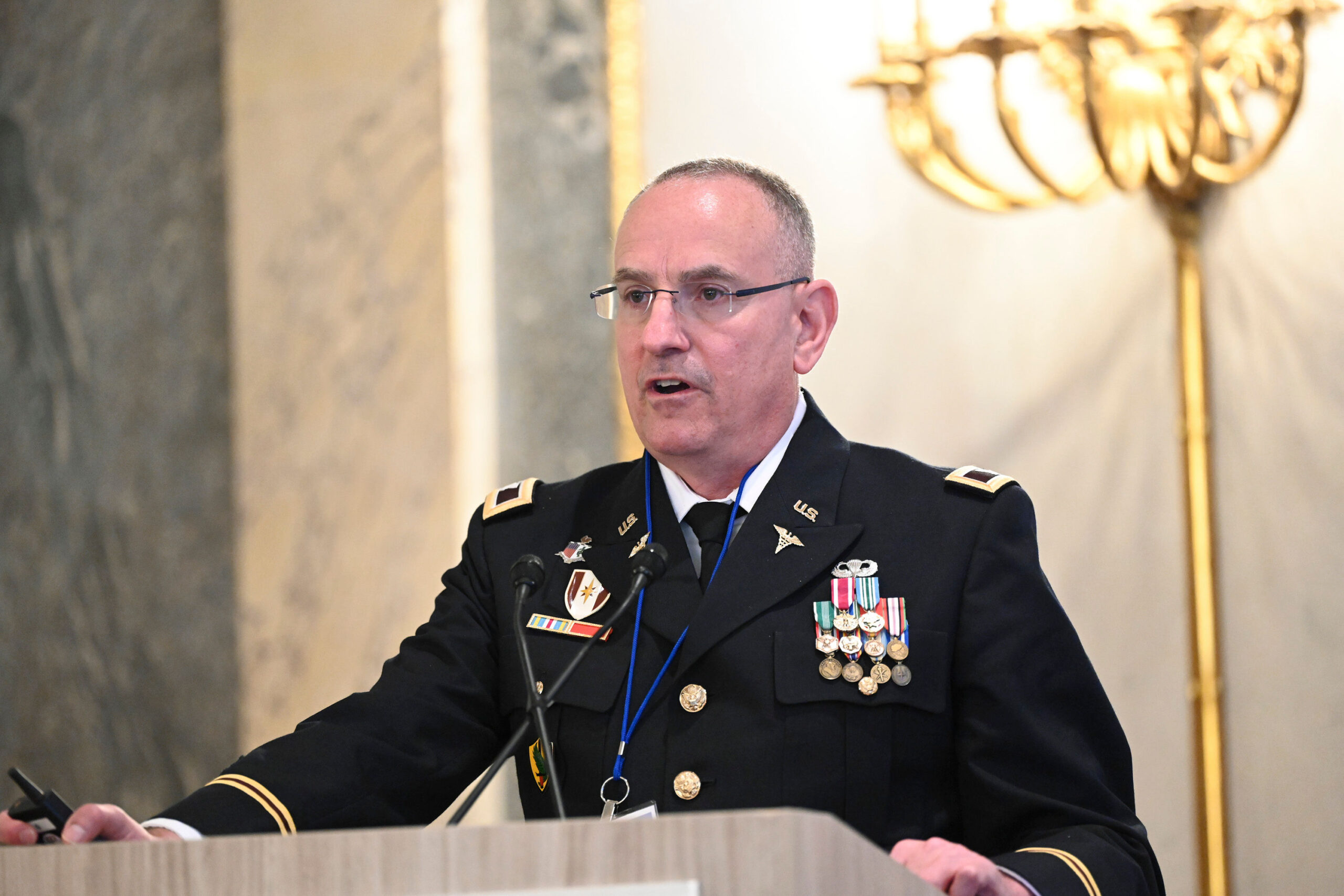
Dr. Martin Schreiber, M.D. is a Colonel in the United States Army Reserve and a trauma surgeon with decades of experience.